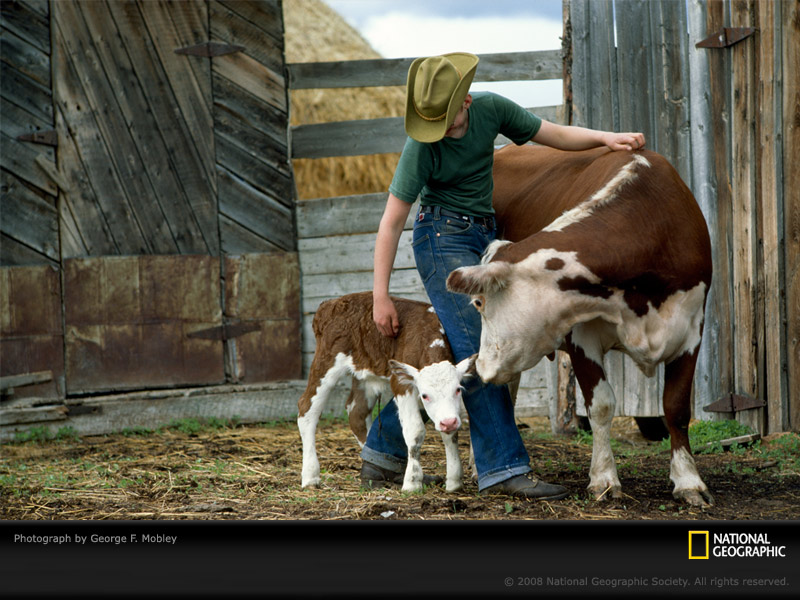
Today we are talking about a third section of Eric Schlosser's "Fast Food Nation"; from chapter 6 through 9. In these chapters, Schlosser opens our eyes on the meat industry; taking us from the ranch to the meatpacking companies.
On the Range
When visiting a local farmer in Colorado Springs, Hank took Schlosser on a tour of the land. During which, he described the type of farming that he took part in and compared it with the damage caused to the land by many of the residential areas taking over the West. Hank's farming uses a technique inspired by the grazing patterns of elk and buffalo herds. His ranch was divided up into 35 separate pastures and then allowed his cattle to spend ten or eleven days in each area before moving onto the next. This would allow the native plants, the blue grama and buffalo grass time to recover. In contrast to his methods, the runoff from the Colorado Springs city areas caused the land to erode beside the creek, carrying silt and debris downstream all the way to Kansas and costing ranchers to lose part of their land each year.
According to Schlosser, "America's independent cattlemen have truly become an endangered species." (136) Today, ranchers face all kinds of economic problems; including rising land prices, stagnant beef prices, oversupplies of cattle, increase shipments of live cattle from Canada and Mexico, development pressures, inheritance taxes, health scares about beef, and the growth of the fast food chains encouraging consolidation in the meatpacking industry (Schlosser, 136). While in 1968, fast food chains like McDonald's bought their ground beef from about 175 local suppliers, that number has now been reduced to about five. These few large corporations, then, have gained a stranglehold on the market and use unfair tactics to drive down the price of cattle (Schlosser, 136). While the excelling of these few large companies really affects the ranchers negatively, they are also protected by alliances known as "trusts". In the early 20th century, these trusts could be broken up by "trustbusters", or government officials who believed that concentrated economic power posed a grave threat to American democracy. However, in 1980, the Regan administration allowed the large companies to merge and combine without fear of antitrust enforcement, narrowing the meatpacking companies down to a main four: ConAgra, IBP, Excel, and National Beef who slaughter about 84% of the nation's cattle (Schlosser, 137). The deceased prices of cattle have also decreased the rancher's pay from 63 cents to about 46 cents for every retail dollar spent on beef. Many times, the independent farmers have a very difficult time figuring out what their cattle are actually worth in addition to having a hard time finding a buyer for them. According to a report by Nebraska's Center for Rural Affairs, "A free market requires many buyers as well as many sellers, all with equal access to accurate information, all entitled to trade on the same terms, and none with a big enough share of the market to influence price. Nothing close to these conditions now exists in the cattle market." (Schlosser, 138)
Schlosser tells us that, "many ranchers today now fear that the beef industry is deliberately being restructured in the lines of the poultry industry." (139) Today, about eight chicken processors control about 2/3 of the American Market. With the creation of the Chicken McNugget, chicken was transformed into something that had to be carved at the dinner table to eat, into something that could be eaten behind the wheel (Schlosser, 139). From there, the consumption of poultry greatly increased and fast food restaurants quickly had to add chicken options to their menus. According to Schlosser, "twenty years ago, most chicken was sold whole; today about 90% of the chicken sold in the United States has been cut into pieces, cutlets, or nuggets." (140) The chicken processing companies, like Tyson, supply the feed, veterinary services, and technical support to the chicken growers. The growers supply the land, the labor, the poultry houses, and the fuel. To build one of these houses can cost anywhere around $150,000 and each can hold about 25,000 birds (Schlosser, 141). "The typical grower", according to Schlosser, "has been raising chickiens for about fifteen years, owned three poultry houses, remained deeply in debt, and earned perhaps $12,000 a year." (141)
In addition to the narrowing of the meatpacking industry having an effect on cattle prices, it has also caused a fear among the independent ranchers to speak out against them. In a 1996 USDA investigation, Schlosser tells us that many ranchers were afraid to testify against the large meatpacking companies, fearing retaliation and "economic ruin" (143). If a rancher were to speak out against them, the companies would simply stop bidding on their cattle and send them into a financial crisis.
Today it is nearly impossible for ranch lands to be handed down generations and kept in the ranching family. Doing so often forces the farmers to sell off chunks of land in order to afford it, but which also diminished the lands productive capacity when most is turned into residential areas. However, some trusts do exist in places like Colorado, where ranchers can donate future development rights to the trust in order to receive immediate tax breaks and the prospect of lower inheritance taxes (Schlosser, 145). This land will then remain private property, but by law can never be turned into golf courses, shopping malls, or subdivisions (Schlosser, 145). While these trusts are doing their best to save this farm land, they have thus far protected about 40,000 acres. This may seem like a significant achievement until you realize that ranchland in Colorado is now vanishing at the rate of about 90,000 acres a year.
In 1998, husband, father, and ranch owner Hank took his own life at the age of 43. Schlosser says that "it would be wrong to say that Hank's death was caused by the consolidation and homogenizing influence of the fast food chains, by monopoly power in the meatpacking industry, by depressed prices in the cattle market, by the economic forces bankrupting independent ranchers, by the tax laws that favor wealth ranchers, by the unrelenting push of Colorado's real estate developers. But it would not be entirely wrong." (146) Schlosser reveals that the suicide rate among ranchers and farmers in the U.S. is now about three times higher than the national average (146). "As the rancher's traditional way of life is destroyed, so are many of the beliefs that go with it." (Schlosser, 146) For ranchers, "the land that is being lost is not just a commodity. It has meaning that cannot be measured in dollars and cents. It is a tangible connection with the past, something that was meant to be handed down to children and never sold." (Schlosser, 147) According to Osha Gray Davison's observations, "To fail generations of relatives… to see yourself as the one weak link in a strong chain… is a terrible, and for some, and unbearable burden." (147)
Cogs in the Great Machine
"Greeley, Colorado is a modern-day factory city where, according to Schlosser, cattle are the main units of prrodcution, where workers and machines turn large steer into small, vacuum-sealed packages of meat" (149). Over the last two decades, the industrialization of cattle-raising and meatpacking has completely changed the ways beef is produced and the towns that produce it. "They have turned one of the nation's best-paying manufacturing jobs", Schlosser tells us, "into one of the lowest-paying, created a migrant industrial workforce of poor immigrants, tolerated high injury rates, and spawned rural ghettos in the American heartland" (149).
 |
| Chicago Stockyard |
For more than a century, according to Schlosser, Chicago reined as the meatpacking capitol of the world. "The Beef Trust was born there, the major meatpacking firms were headquartered there, and roughly forty thousand people were employed there in a square mile meat district anchored by the Union Stockyards" (Schlosser, 152). While the industry itself seemed to be a wonderful operation, one writer published a book that told many real truths about the meatpacking industry; Upton Sinclair. In his book, "The Jungle", Sinclair described "a litany of horrors: severe back and shoulder injuries, lacerations, amputations, exposure to dangerous chemicals, and memorably, a workplace accident in which a man fell into a vat and got turned into lard. The plant kept running, and the lard was sold to unsuspecting consumers" (152). Sinclair argued that "human beings had been made cogs in the great packing machine, easily replaced and entirely disposable" (Schlosser, 152). A federal investigation then took place to discover if Sinclair's book actually held some validity, and it was found that his book was really quite accurate (Schlosser, 152). The outrage that the book inspired led congress to enact food safety legislation in 1906, however little was done to improve the lives of the packinghouse workers, whose misfortune had inspired Sinclair to write the book (Schlosser, 153). Later, in 1961, Holman and Anderson opened their first slaughter house, and applied the same labor principles to meatpacking as McDonald's had applied to making hamburgers: an assembly line production (Schlosser, 153). They used these principles to not only slaughter cattle, but to also create smaller cuts of meats in order to package them into smaller units. This enabled the companies to fire most of their skilled and unionized butchers. When the company later had issues with workers striking because of low pay and bad conditions, Holman went to Moe Steinman, who had connections with the New York mob, to make him a powerful ally and have him assist in ending the butchers' boycott of IBP's boxed beef (Schlosser, 154). Eventually, Holman and IBP were tried and convicted for bribing union leaders and wholesalers in 1974. However, many of their same connections now hold jobs within the company (Schlosser, 155). Today, the working conditions, pay, and employment within the meatpacking industry continue to decline. "The local meatpacking industry that once employed 40,000 people now employs about 2,000. 95% of its jobs have moved elsewhere and the last of the Chicago stockyards closed down in 1971" Schlosser, 157).
While you would think the government would do its best to put a stop to the concentration of meatpacking companies, the Reagan administration did not, in fact, oppose the disappearance of hundreds of meatpacking firms. "On the contrary, it opposed using antitrust laws to stop the giant meatpackers" (Schlosser, 158). These companies then worked hard to increase their profits considerably, even if it meant encouraging employees to break the law. During an 8 year period, over 45 thousand truckloads of birds were deliberately misweighed at a ConAgra processing plant in order to make the birds seem lighter in order to pay less for more (Schlosser, 159). In another instance, ConAgra cheated farmers in Indiana by doctoring samples of their crops to make the grains seem of lower quality to pay less for it (Schlosser, 160).
"Today", according to Schlosser, "roughly two thirds of the workers at the beef plan in Greeley cannot speak English." (160) Most of them are Mexican immigrants seeking better pay, a place to live, and the hopes of health insurance. However, this health insurance is only gained after working for the company six months, and few employees can actually make it that long. In addition to the rise in immigrant workers, the Immigration and Naturalization Service estimates that "about 1/4 of all meatpacking workers in Iowa and Nebraska are illegal immigrants." (Schlosser, 162) These workers are lured to the meatpacking jobs through the promise of steady work and housing. In 1994, one company (GFI America) brought Mexican immigrants to Minneapolis, Minnesota with these very promises. They picked up 39 people, bused them over the boarder, and dropped them off across from a People Serving People homeless shelter. The shelter agreed to house them because they did not have any money, but they were enraged at the company who tried to use the shelter as a means for housing their illegal immigrant workers (Schlosser, 163). One county official commented, "Our job is not to provide subsidies to corporations that are importing low-cost labor" (Schlosser, 163). In addition to taking advantage of people in this way, the meatpacking companies also took advantage of the states they were located in by demanding lowering taxes paid by large corporations and wealthy executives. When ConAgra threatened to move if they did not receive the tax breaks (guaranteeing Harper personally a gain of $295,000), the state granted them the breaks. But despite all of the efforts Nebraska made to keep ConAgra in their state, they still moved the company in 1997 to South Dakota, a state with no corporate taxes and no personal income tax (Schlosser, 164).
 |
| ConAgra Fods |
When a slaughterhouse opened in Lexington in 1990, the plant caused a major change in the surrounding area, bringing with it a drug dealing economy, more crime, and more immigrant workers. In addition to this, the plant also came with a distinct smell of "burning hair and blood, that greasy smell, and the odor of rotten eggs" (Schlosser, 165). According to Schlosser, before the company moved into Lexington, they held a meeting with the community in order to answer questions the members of the community had. One asked about the turnover rate of employment, to which IBP responded it would have a stabilized workforce - 80-90% being stable workers. When asked about the local hiring, IBP responded that they would not bring in an hourly workforce. Finally, an IBP executive and vice president of engineering assured the audience that "the new plant in Lexington would not foul the air. No odor would be noticeable even a few feet away from the plant. In any event, the smell emitted by slaughterhouse lagoons (where they put the feces and urine by the way) would be sweet, not objectionable. And the small from the slaughterhouse itself would be no different from that which you produce in your kitchen when you cook." (Schlosser, 166)
The Most Dangerous Job
When Schlosser first arrives at the meatpacking factory, he is taken on a tour where he is able to see all the different jobs the employees do, starting from the end and working to the beginning. First are the slicers, employees make up mostly of women who stand shoulder to shoulder and slice the sides of beef into small cutlets to be packed and shipped (Schlosser, 169). Next is the worker who uses a powerful saw to slice cattle into two halves (Schlosser, 170). Then is the "sticker", the worker who does nothing for eight hours except sand in a river of blood and slitting the neck of a steer every ten seconds (Schlosser, 171). Finally is the "knocker", the worker who welcomes the cattle into the building and shoots them in the head with a captive bolt stunner (Schlosser, 171).
According to Schlosser, "meatpacking is now the most dangerous job in the United States. Despite the use of conveyer belts, forklifts, dehiding machines, and a variety of power tools, most of the work in the nation's slaughterhouses is still performed by hand." (Schlosser, 172) Most of the injuries incurred while working in a slaughterhouse are caused by knives. Many of the workers who slice the sides of beef make up to 10,000 cuts during their eight hour shift. Combine this with a large amount of pressure to work as fast as possible, and the hazards of cut injuries gets really high. While the old meatpacking companies of Chicago would slaughter about 50 cattle a day, today some slaughter up to 400 cattle an hour (Schlosser, 173). According to Schlosser, this unrelenting pressure to keep up with the speed of the line has encouraged worker to abuse methamphetamine (174). In addition to this, workers are also discouraged from reporting any injuries because the annual bonuses of plant foremen and supervisors are often bases off of a low injury rate (Schlosser, 175). Once injured, the worker is then given lower hourly wages, some of the more unpleasant tasks, and are encouraged to quit. After all, injured workers are a drag on profits from a purely economic point of view (Schlosser, 175).
Schlosser tells us that some of the most dangerous jobs within the meatpacking industry today are those performed by the late-night cleaning crew (176). Many of these workers are illegal immigrants who are employed through a sanitation company and receive about 1/3 lower hourly wages than those of regular production employees (Schlosser, 176). These employees are usually responsible for cleaning all of the equipment as well as the bloody floors, which they use a mixture of water and chlorine heated to about 180 degrees to do so (Schlosser, 177). This, however, creates a large amount of fog in the building and inhibits visibility. The workers also complain about the smell of the chemicals mixing in with the blood, saying that it is so power that it won't wash off; "no matter how much soap you use after a shift, the smell comes home with you, seeps fro your pores." (Schlosser, 177) One of the most horrendous deaths that Schlosser talks about in this section happens to a group of late-night cleaning crew members. At a National Beef plant in Liberal, Kansas, "Homer Stull climbed into a blood-collection tank to clean it, a filthy tank thirty feet high. Stull was overcome by hydrogen sulfide fumes. Two coworkers climbed into the take and tried to rescue him. All three men died." (Schlosser, 178). The fine was $480 for each of the men's death.
In order to help keep tabs on the meatpacking factories, companies like OSHA complete inspections on the facilities. The typical American employer could expect an OSHA inspection about once every eight years (Schlosser, 179). However, the meatpacking industries, with the help of the Reagan administration pushed for the deregulation of inspections, limiting them to voluntary compliance in 1981 (Schlosser, 179). This new regulation required OSHA employees to look at a company's injury log before going inside the plant. If the records showed a lower than average amount of injuries, then the inspector had to turn around and leave. These logs, however, were kept and maintained by the company officials (Schlosser, 179). OSHA's voluntary compliance policy did, according to Schlosser, reduce the number of recorded injuries in meatpacking plants. However, it did not reduce the number of people getting hurt (Schlosser, 179). One of IBP's former vice presidents says that "the real blame for the high injury rate at the company lies not with the supervisors, nurses, safety directors, or plant manager, but with IBP's top executives" who make the decisions and decide on the health and safety programs in the company (Schlosser, 182).
During his time in visiting meatpacking factories, Schlosser was told many stories of horrible injuries incurred while working by the employees. He tells us that "each of their stories was different, yet somehow familiar, linked by common elements - the same struggle to receive proper medical care, the same fear of speaking out, the same underlying corporate indifference" (186). One story in particular really struck home: that of Kenny Dobbins. Kenny was a Monfort employee for almost sixteen years. During his time working for the company, Kenny suffered from a pair of severely herniated disks in his back, a severe chemical burn in his lungs, gashes in his back and face that resulted from being hit by a train while driving scraps of meat in a truck with a filthy and cracked windshield, and a massive heart attack (Schlosser, 189). While recuperating from his heart attack, Monfort fired him and never bothered to contact him to let him know. He only found out when his payments to his insurance company kept coming back (Schlosser, 190). Kenny tells Schlosser that Monfort "used me to the point where I had know body parts left to give. Then they just tossed me into the trash can." Schlosser tells us that "once strong and powerfully built, he now walks with difficulty, tires easily, and feels useless, as though his life were over. He is forty-six years old." (190)
What's in the Meat
"Every day in the U.S., roughly 200,000 people are sickened by a foodborne disease, 900 are hospitalized, and 14 die", says Schlosser (195). He continues by telling us that recent studies have shown these foodborne disease pathogens can actually precipitate into long-term ailments; such as heart disease, inflammatory bowl disease, neurological problems, autoimmune disorders, and kidney damage (Schlosser, 195). However, while researchers have gained important insights into the links between modern food processing and the spread of dangerous diseases, the nation's leading agribusiness firms have opposed any further regulation for food safety practices (Schlosser, 196). They do not want any further testing of these food products in order to keep selling and making money, no matter the cost of health to the general public. In a nationwide study published by the USDA in 1996, it was discovered that 7.5% of ground beef samples taken at processing plants were contaminated with Salmonella, 11.7% with Lysteria monocytogenes, 30% with Staphylococcus aureus, and 53.3% with Clostridium perfringens, all pathogens that make people sick. When looking further into the explanation for why eating a hamburger can make you seriously ill, Schlosser found out an uncanning fact about much of our meat processing: there's manure in the meat (Schlosser, 197).
Prior to the 1920s, ground beef had an extremely bad reputation; it was believed to be made from old, putrid meat heavily laced with chemical preservatives. However, during the 1920s, White Castle (the nation's first hamburger chain) worked hard to dispel this image. Their success along with the uprising of drive-in restaurants turned the once lowly hamburger into America's national dish (Schlosser, 198). According to Schlosser, in 1993 the chain Jack in the Box discovered that a bunch of hamburger meat was contaminated with E. Coli when customers became ill (198). During the incident, more than 200 customers were hospitalized and four died. In the eight years after the incident, approximately half a million Americans, the majority of them children, have been made ill by E. coli. Thousands have been hospitalized, and hundreds have died (Schlosser, 199).
Schlosser then goes further to describe one incident of E. coli poisoning that happened to the president of Safe Tables Our Priority (STOP), Nancy Donley. Nancy's son contracted the E. coli bug after eating a contaminated hamburger. What started with abdominal cramps soon turned into blood filled stool, pressure in his head, and faltering lungs. Alex was essentially being eaten from the inside out by the bug as it destroyed his inner organs (Schlosser, 200). Near the end, Alex suffered hallucinations and dementia, the bug liquefying his brain. He died six days after first getting ill, and a week after his mother's birthday (Schlosser, 200). E. Coli is resistant to many environments. "It can survive in acid, salt, and chlorine. It can live in fresh water or seawater. It can live on kitchen countertops for days and in moist environments for weeks. It can withstand freezing. It can survive heat up to 160 degrees Fahrenheit. An infection with E. coli can be caused by as few as five organisms. A tiny uncooked particle of hamburger mean can contain enough of the pathogen to kill you." (Schlosser, 201) Interestingly enough, the most common cause of foodborne outbreaks has been the consumption of uncooked ground beef (201). According to Schlosser, the contaminated meat begins from the very start of the animal's life; from the food and water they are given. While we wouldn't eat dirty food or water, we still allow this to be given to the animals we later eat (Schlosser, 202). In addition to the possiblity of manure being in their food and water, animals also consume parts of ground up dead animals; such as pigs, horses, poultry, and cattle. But "cattle are designed to eat grass and, maybe, grain", Schlosser tells us, "The have four stomachs for a reason - to eat products that have a high cellulose content. They are not designed to eat other animals." (202) Our meat is also contaminated along the production line of the meatpacking industry; when the intestine is removed. Since the hides are taken off the cattle by machine, if the hide has been inadequately cleaned, chunks of dirt and manure may fall from it onto the meat (Schlosser, 203). According to Schlosser, in one slaughter house in Nebraska, the hourly spillage rate at the gut table has run as high as 20%, with stomach contents splattering one out of five carcasses (Schlosser, 203). With this many cattle stomachs being spilled onto our meat, it is important to note that about 1% of the cattle are carrying E. coli in their gut. This goes up to about 50% during the summer (Schlosser, 203).
Schlosser reveals to us that "after reading "The Jungle" President Theodore Roosevelt ordered an independent investigation of the books claims. When it confirmed the accuracy of the book, Roosevelt called for legislation requiring mandatory federal inspection of all meat sold through interstate commerce, accurate labeling, and dating of canned meat products, and a fee-based regulatory system that made meatpackers pay the cost of cleaning up their own industry" (205). The meatpacking industry was not happy about this however. They claimed that "there is no limit to the expense that might be put on us. Our contention is that in all reasonableness and fairness we are paying all we care to pay." (Schlosser, 205) Keep in mind, however, that the federal inspection plan would cost the meatpackers less than a time per head of cattle (Schlosser, 205). Later, according to Schlosser, the Reagan and Bush administrations cut spending on public health measures and staffed the U.S. Department of Agriculture with officials far more interested in government deregulation than in food safety (206). "The USDA became largely indistinguishable from the industries it was meant to police" (Schlosser, 206). In September of 1993, Michael R. Taylor, the new head of the USDA's Food Safety and Inspection Service announced that E. coli would henceforth be considered an illegal adulterant, that no ground beef contaminated with it could be sold, and that the USDA would begin random microbial testing to remove it from the nation's food supply (Schlosser, 207).
After the outbreak at the Jack in the Box restaurant, Tavid Theno who emerged as a fast food maverick, demanded that managers attend a food safety course, that every refridgerated delivery truck have a record-keeping thermometer mounted inside it, that every kitchen grill be calibrated to ensure adequate cooking temperature, and that every grill person use tongs to handle hamburger patties instead of bare hands (Schlosser, 208). Theno would like to continue his efforts by giving meatpacking companies different grades depending on how clean their meat is, believing this would help give companies incentive to take better care with their meat production (Schlosser, 209). In order for this program to take place, the price of the chain's ground beef would raise about a penny per pound (Schlosser, 210).
In addition to the government stepping in with deregulation of meatpacking companies, a great deal of effort was also spend denying the federal government any authority to recall contaminated products. Under current law, the USDA cannot demand a recall of meat. It can only consult with a company that has shipped bad meat and suggest that it withdraw the meat from the interstate commerce (Schlosser, 211). The recall, then, has become voluntary, and is thus under no legal obligation to inform the public, or the state health officials, that a recall is taking place (Schlosser, 212). Today, the USDA informs the public about every Class 1 recall, but will not reveal exactly where contaminated meat is being sold, unless it is being distributed under a brand name in a retail store (Schlosser, 213). Since the Jack in the Box outbreak, the Clinton administration backed legislation to provide the USDA with the authority to demand meat recalls and impose civil fines on meatpackers. However, republicans in Congress failed to enact not only that bill, according to Schlosser, but also similar legislation introduced in 1996, 1997, 1998, and 1999.
According to Schlosser, "though the meatpacking industry has fought almost every federal effort to mandate food safety, it has also invested millions of dollars in new equipment to halt the spread of dangerous pathogens", including steam pasteurization cabinets that kill off most of the E. coli by exposing it to radiation (216). According to the American Medical Association and the World Health Organization, these foods that have been irradiated are apparently safe to eat (Schlosser, 217). But the USDA would like for a special label to be put onto products that show a symbol for radiation. Beef Industry Food Safety Council , however, is asking them to change their labeling laws to make the labeling of the foods voluntary (Schlosser, 218).
Schlosser continues his discussion of meat by telling us that "most of the questionable ground beef in the U.S. was purchased by the USDA and then distributed to school cafeterias throughout the country (218). However, this cheap ground beef was not only the most likely to be contaminated with pathogens, but also the most likely to contain other hazardous materials; such as bones. In the beginning of the 2000-2001 school year, the USDA enacted new rules for cafeteria meat that required testing for pathogens, and old/sick cattle could no longer be processed into the ground beef that the USDA buys for children (Schlosser, 221). The meatpacking industries, of course, immediately opposed the new rules.
Today, the meatpacking industry is not willing to perform the sort of rigorous testing for fast food that it refuses to do for the general public (Schlosser, 221). What this means is that the meat we bring home into our kitchens today may be considered a potential biohazard, and more so than the meat that is jacked up with sodium and fats found in fast food restaurants. What, then I ask, is the priority of these meatpacking companies? Definitely not our health.
Join me next week for the end of Eric Schlooser's book (Chapter 10, the epilogue, and the afterward) where we will uncover and learn even more about the rise of the fast food nation.
Exercise: Today is YOGA! Grab your mat, some soothing music, and enjoy an hours worth of a yoga workout. :)
Eat: Today when I got home, there was seriously NOTHING to eat in my house. My sister and I decided to make pancakes for dinner and boy were they yummy. Whenever you make pancakes, a quick tip that will up their tastiness in a fast second is to put a teaspoon of vanilla into the batter. This is the best secret ingredient for pancake making. In addition to vanilla, we also mashed up some bananas and threw in some chocolate chips. Not the healthiest I will admit, but still wonderfully delicious.
Relax: Today I enjoyed just hanging out with my sister and catching up on some of our TV shows. I don't get to just chill out with her very often so I found it really nice and relaxing. I want to encourage you to hang out with a sibling of yours today, or give them a call. It's always good to spend time with your siblings and stay important parts of each other's lives.